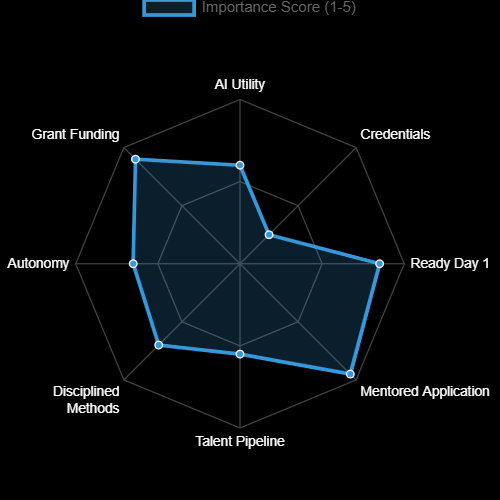
The Data: Why Technical Integrity is the Top Priority
I recently conducted a survey of 54 IT Directors, CTOs, and Technical Managers. I wanted to move past the anecdotes and get a clear, data-driven pulse on what actually matters when it comes to team performance and talent development.
The results were unequivocal. We are witnessing a fundamental shift in what technical leadership values, and it has massive implications for how we train the next generation of engineers.
The Survey Results: A Priority Shift
When asked to rank the importance of various factors in team upskilling (on a scale of 1-5), the hierarchy was clear:
-
Mentored Application (4.89): The top priority. Leaders are done with solo learning.
-
Grant Funding (4.76): Budget friction is real, but leaders want it solved through strategic partnerships like OhioMeansJobs and TechCred.
-
Day 1 Readiness (4.63): The expectation is immediate contribution, not a year-long “ramp-up.”
-
Industry Credentials (3.48): The lowest-ranked factor. The “badge” has lost its luster.
Overcoming the Innovation Bottleneck
In the world of Evidence-Based Management, we often look at technical integrity as the foundation for a team’s capacity to evolve. When a team lacks this discipline, they hit an innovation bottleneck. Instead of delivering new features, the team spends the majority of their time fixing regressions and untangling “vibe code”—output that looks correct on the surface but lacks the structural integrity to survive a production environment.
By focusing on mentored application, leaders are essentially trying to clear this bottleneck. They recognize that a team’s Ability to Innovate is only as strong as the engineering standards they uphold.
Why Technical Integrity is a Core Metric
In the world of Evidence-Based Management, we often look at Technical Integrity as the foundation for a team’s “Ability to Innovate.” If your engineers are simply “vibe coding”—relying on AI-generated snippets without understanding the underlying architecture—your DORA metrics will suffer.
High-performing teams maintain a high deployment frequency because they trust the integrity of their code. When we prioritize Technical Integrity over mere credentials, we reduce the friction in the delivery pipeline. This ensures that every iteration delivers maximum value to the customer without the burden of unforeseen technical debt.
Why Mentorship is Winning
The high score for Mentored Application isn’t just about “help.” It’s about Engineering Integrity.
In our current landscape, it is easier than ever to produce “vibe code”—output that looks correct on the surface but lacks the structural integrity to survive a production environment. Technical leaders recognize that the only way to combat this is through disciplined, mentored engineering. They aren’t looking for people who have watched videos; they are looking for people who have been coached to deliver with precision.
Integrity as the Driver of Value
Why do these results lean so heavily toward “Day 1 Readiness” and “Mentored Application”? Because these are the levers that drive Customer Value.
In a value-driven delivery model, every iteration counts. If a team member lacks the disciplined methods to deliver continuously, they become a bottleneck. We maximize the value delivered to the customer by ensuring that every line of code and every business analysis task is performed with an eye toward technical excellence.
When we prioritize Engineering Integrity, we aren’t just being “picky” about code; we are protecting our organization’s Ability to Innovate. By ensuring that talent can deliver from day one, we remove the friction that usually stalls out development cycles.
The NextGen Solution
NextGenTalent Lab was built specifically to address these survey results. We’ve moved away from the “simulated classroom” model because the data tells us it doesn’t work. Instead, we’ve built a 16-week clinical apprenticeship that focuses on:
-
Direct Mentorship: Solving the 4.89/5 demand for guided, real-world application.
-
Disciplined Methods: Ensuring that “Engineering Integrity” is the default setting for every candidate.
-
Continuous Delivery: Training talent to maximize value in every iteration, keeping your innovation pipeline moving.
The data is clear: My network’s IT leaders are looking for more than just certifications. They are looking for the integrity and discipline required to drive real business value.